
Kiavi's purchase: the synergy, the Sixth Street structure, and what the chain shows
Ahead of Figure's Q3 report, a look at the Kiavi deal. Why it fits Figure, how Sixth Street keeps the loans off Figure's balance sheet, and why Kiavi's volume on chain looks lower than expected.
By Shira Zevin, founder of Debloc.ai
As we approach the Q3 earnings report of Figure, let's take a closer look at one of the most interesting developments to watch this quarter - Kiavi's purchase.
Why does Kiavi's deal have high synergy with Figure?
As Figure themselves noted about the purchase, Kiavi's Fix-n-Flip and Rental loans (RTL & DSCR) let Figure, on one side, scale into types of loans where it had only a small share until now. On the other side, these loans are similar enough to Figure's existing products that its tech can be applied with only a small investment, which turns tech enablement into a flywheel of expansion.
On the other hand, Kiavi is what's considered a "classic lender", meaning it's balance-sheet-intensive. That's quite the opposite of where Figure is going: becoming a capital-light marketplace, making most of its revenue from fees rather than interest.
So high synergy aside, this had to be solved. We'll get to that.
There's another interesting aspect - the fact that Kiavi is considered a classic lender also means it's priced like one.
With $7.8B in 2025 originations, Kiavi was valued at about $717M. Figure, with $8.4B in CLMV in 2025, was valued at about $6.2B when the deal was announced.
In other words, Figure's valuation relative to annual loan volume was roughly 8x Kiavi's.
Of course this is normal. Kiavi is a classic BS lender, while Figure is building a capital-light marketplace. But it also shows the opportunity: if Figure can bring Kiavi's volume onto its platform without carrying the loans on its BS, it could price that volume at multiples that Kiavi can only dream of.
But how do we separate the business from its risk, and help Figure realize the full multiple on the volume?
Where Sixth Street steps in
This is where Sixth Street steps in. At the time of the purchase, Figure announced that Kiavi is acquired jointly with Sixth Street, through a newly formed joint venture (JV): Sixth Street put in $179M of the $717M, and on top of that $3B+ of forward purchase commitments.
Sixth Street is an external entity, an independent investment firm, and the JV formed for this deal is a partnership between Figure and Sixth Street, controlled by Sixth Street.
The deal with Sixth Street is 2 phased. At the time of purchase, the Sixth Street JV purchased the already originated Fix-n-Flip loans Kiavi had on its BS, keeping them from landing on Figure's reports.
Then, for every Fix-n-Flip loan (the shorter, higher interest ones) originated from the purchase date onwards, it's worth separating three things: who originates it, who owns and funds it, and whose BS it sits on.
- Who originates it: Kiavi's platform and team, now part of Figure, still run the business. The lender on the loan documents is Kiavi Funding, LLC (and Figure Lending in a few states).
- Who owns and funds it: the Sixth Street-controlled JV. At closing a Kiavi subsidiary was sold into the JV, Figure calls the JV "the first originator" on its platform, and Sixth Street added $3B+ of forward purchase commitments on top.
- Whose BS: not Figure's. Figure describes it as "off-balance sheet RTL origination". The loans sit with the JV, and Figure holds only its stake in the JV.
Rental loans are simpler. They are originated and funded by Figure Lending LLC, and stay on Figure's BS.
So how does Figure get monetary value from the Fix-n-Flip? Figure is to drive those loans' funding and distribution via Connect, and here come all sorts of fees it charges as a marketplace, like "Ecosystem and technology fees", which are the main revenue stream ($73M of $226M net revenue in Q2 2026).
On paper, this looks like an attractive structure for Figure.
What does the blockchain tell us about Kiavi's activity?
Can we track anything on chain? Yes, with caveats.
First, Figure hasn't reported Kiavi's numbers yet, so all of the below is still considered an estimation.
Second, looking at the address we assume to be Kiavi (see here for the reasons), we see 2 phenomena.
We can actually empirically split the loans originated into 2 buckets. Those buckets resonate with the Fix-n-Flip and Rental buckets.
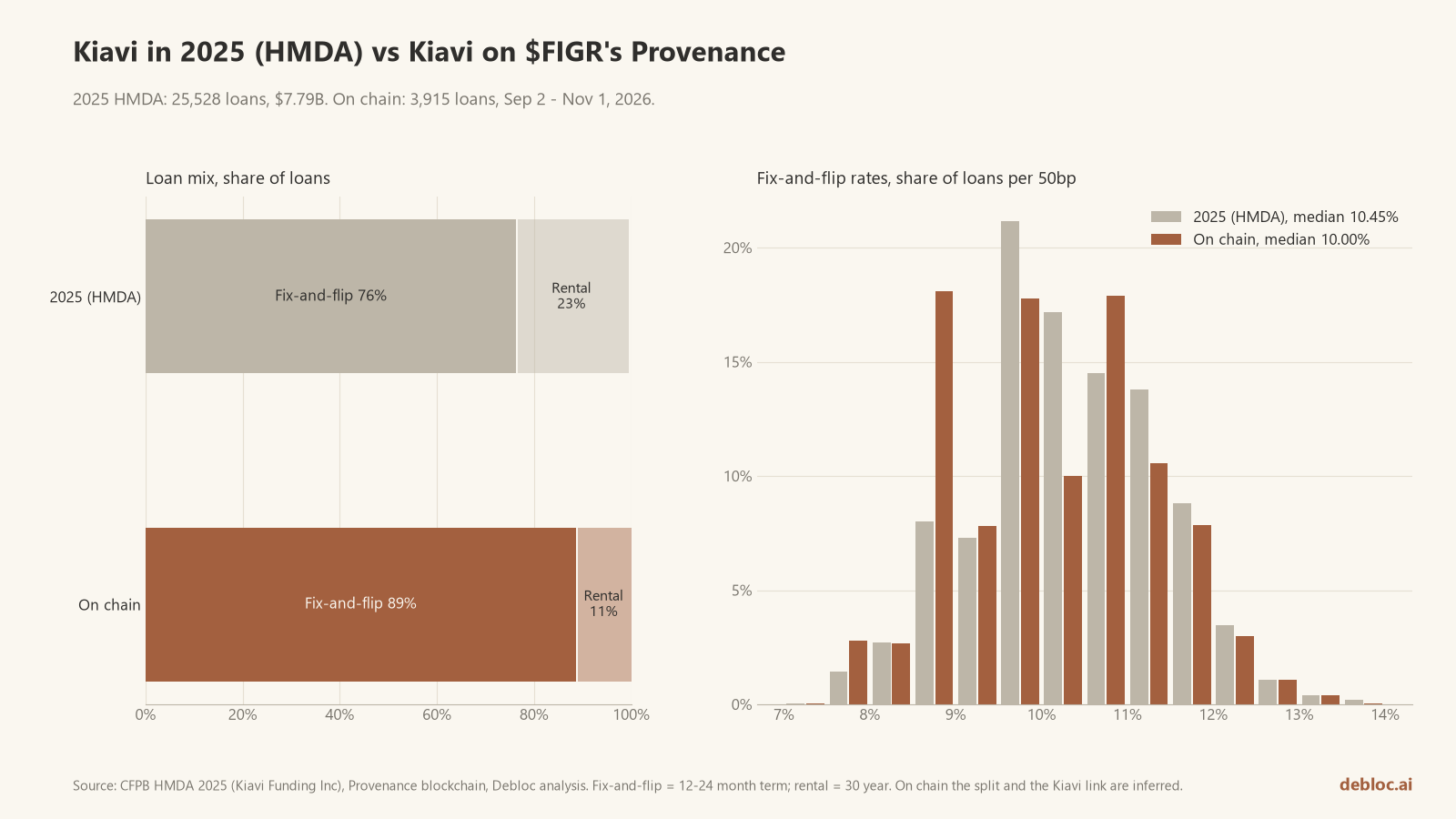
One bucket is 438 loans that look like Rental loans: rates of about 6.75% to 7.9%, almost none below $100k and none above $1M. The other is 3,401 loans that look like Fix-n-Flip: rates of about 8.75% to 11.5%, one in five below $100k, and 117 loans above $1M.
The other phenomenon is that the volume generated by what we assume is Kiavi paces at a much lower volume than anticipated by previously published numbers:
- 2025 was $7.8B, about $31M per business day.
- Q1 2026 (published by Kiavi) was $1.8B, about $30M per business day.
- Q2 2026 was $2.1B, about $33M per business day.
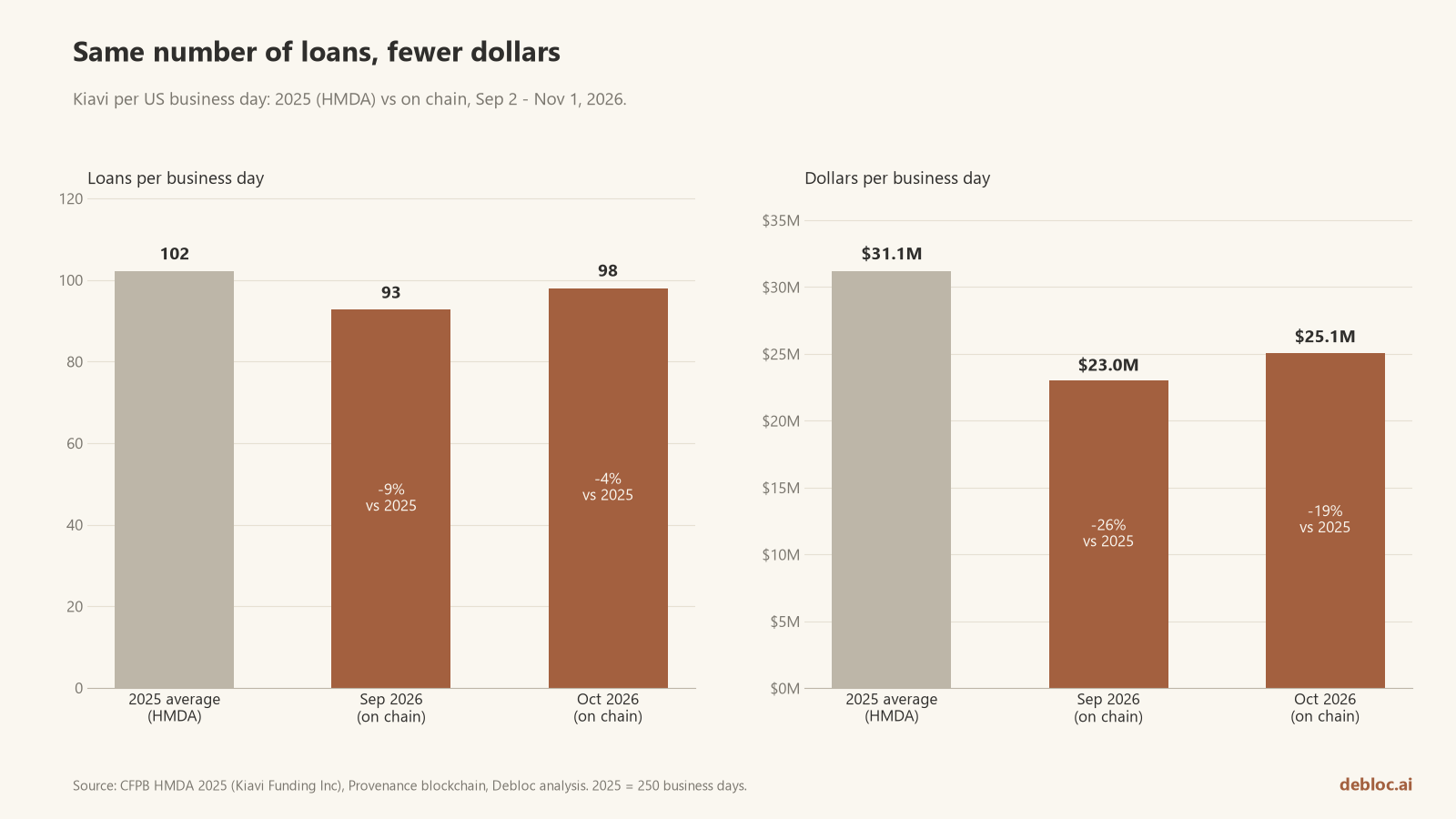
- Current volumes amount to about $1B since September 2 ($460M in September and $500M in October), $23-25M per business day. That is a pace of about $6.3B a year.
The chart at the top of this post puts it per business day. The number of loans is close to 2025: 93 a day in September and 98 in October, against 102. The dollars are not: $23.0M and $25.1M a day, against $31.1M, 19-26% lower.
So the gap is not in the number of loans, but in their size.
Furthermore, when we take the HMDA file of Kiavi (which contains a loan-by-loan record for 2025 with explicit volumes), we see that Fix-n-Flip loans on chain are actually 25-30% LOWER than in 2025 ($260k on average against $347k), while Rental loans are slightly larger ($183k against $173k).
Is Kiavi in trouble?
Not necessarily. There's a more interesting explanation.
It's just the dynamics of these RTL loans.
As noted in previous ABS deals Kiavi securitized through its LHOME Mortgage Trust shelf (24 deals since 2019), a Fix-n-Flip loan can be fully funded at closing, or partially funded, with a commitment to fund the rest later. So at origination the customer usually gets about 75% of the loan (based on the loan-level files Kiavi filed with the SEC for its last five deals), and the rest is extended upon the borrower's request: after completing part of the renovation with their own funds, the borrower asks for a draw, which is paid only after an inspection confirms the work was done.
Kiavi's latest deal, LHOME 2026-RTL1 from early 2026, shows it in numbers. Its 585 loans had an average unpaid balance of $256k at the cut-off date. This is much closer to the amount actually advanced to borrowers (the initial advance plus subsequent draws) than to the original loan commitment. It's almost exactly the $260k average we see on chain, and far from the $347k average original loan amount in HMDA. Rental loans, which are paid out in full at closing, show no such gap.
This is strong evidence for the partial-funding explanation, not proof that every dollar of the gap comes from it.
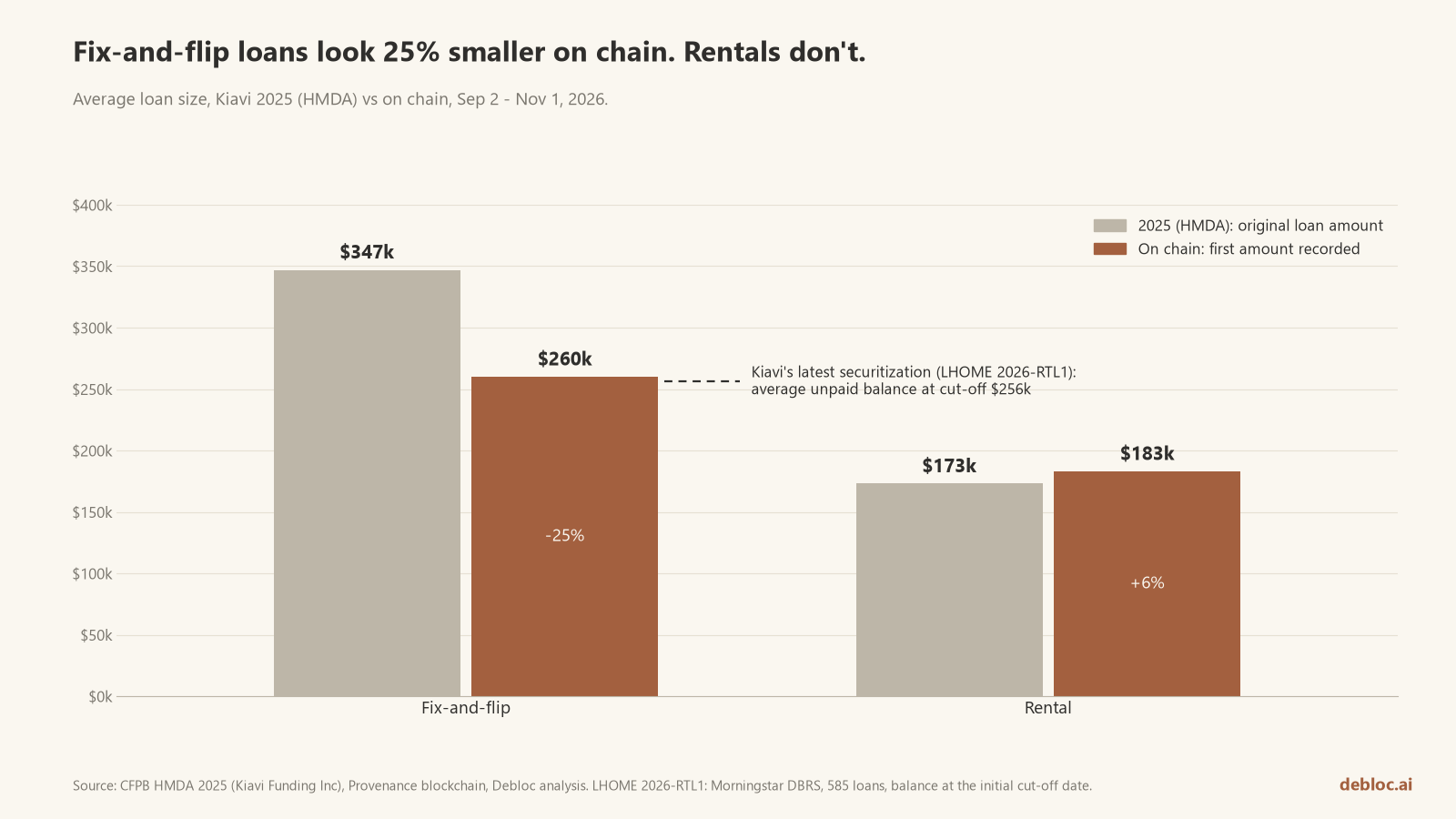
So the numbers we see on chain for Kiavi's RTL are most probably partial. It would be interesting to see formal numbers in the upcoming earnings, to understand how Figure counts them under CLMV: with the full 100%, or the actual amount extended so far.
Until then, enjoy the daily tracking of Kiavi's volume on chain at debloc.ai.