
Figure Earnings Preview: What to Expect, and What Can We Learn From the Chain?
Figure's earnings tomorrow bring together a few interesting things worth watching. Let's look into them, one by one.
Figure's earnings tomorrow bring together a few interesting things worth watching. Let's look into them, one by one.
First, this is going to be the first quarter where Kiavi's volume will be accounted for. Though only live for one month during the quarter, this is the first indication of how this union will look in practice – from volume and take rate to other potential synergies.
Second, take rate. As Michael Tannenbaum noted last quarter, they expect it to be at the lower end of the expected range, meaning around 3.5%. Will it actually land there, or will we see it slip even lower?
Third, Q4 estimations. Those who follow the numbers know that Q4 is expected to close significantly lower than Q3, potentially by up to 10%. With holidays and other seasonal factors, this is more or less expected. On the other hand, Kiavi's inclusion will camouflage some of that decrease, so it will be interesting to see how the market reacts to the headline number.
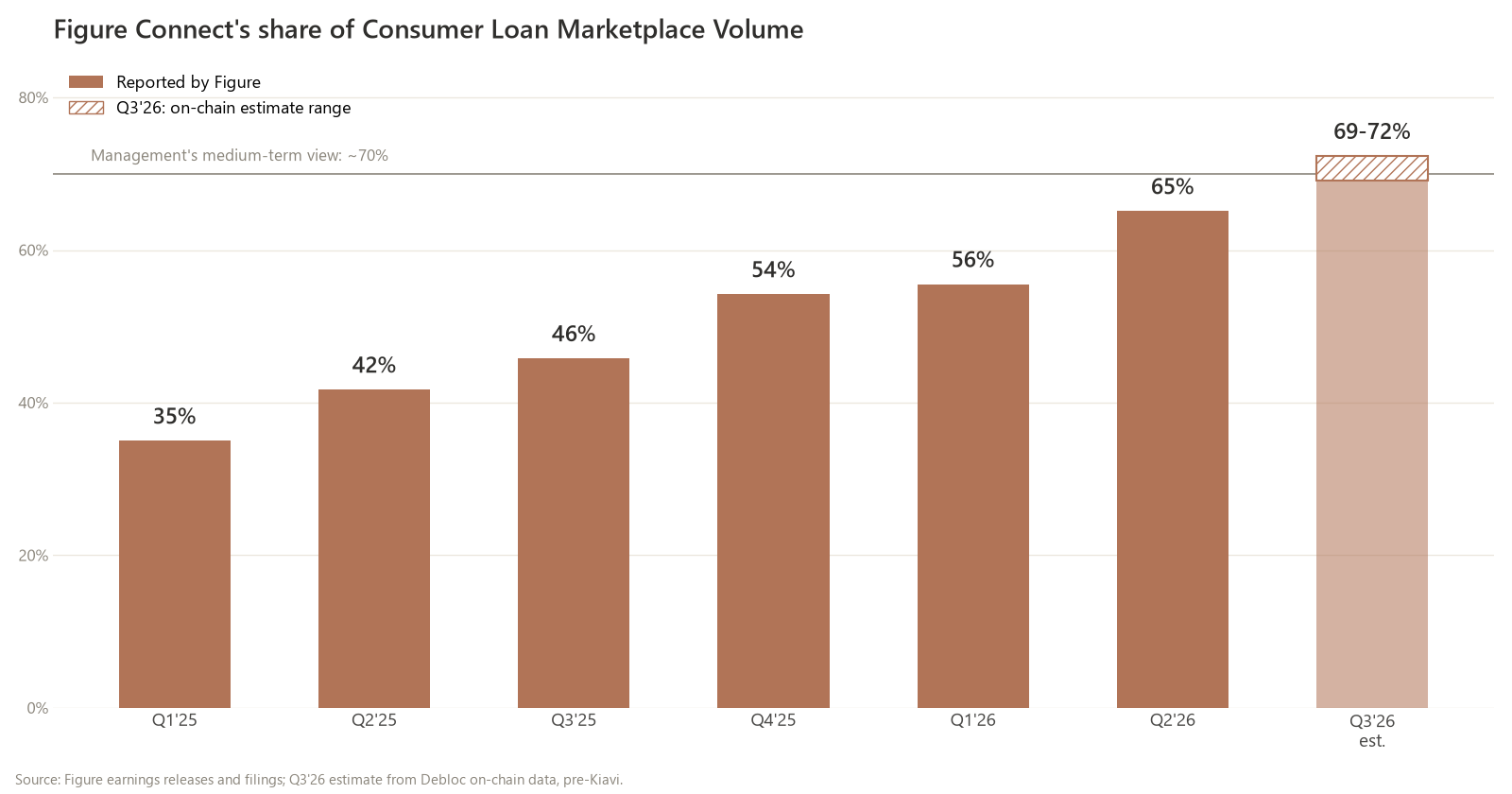
Fourth, Connect volume out of CLMV. It's closely related to the take rate, of course. Management expects it to grow from Q2's 65% share, but just how much higher should we expect it to go?
And fifth, less about fundamentals and more about the share price. FIGR visited a new all-time low just last week, more than 20% below its IPO price. So volatility tomorrow wouldn't be particularly surprising.
Let's take each part (except the share price) and break it down into what we know, what we can read from the chain, and what we can estimate using on-chain data.
Kiavi
Kiavi's volumes are pretty much identified.
In Q3, there were approximately $447M worth of CLMV which will be added to Figure's reported $5.12B, bringing the combined number to around $5.57B.
But there's an interesting caveat here.
Kiavi originates both rental loans and fix-and-flip loans. Fix-and-flip loans are not necessarily fully funded at closing. They can be partially funded, with a commitment to fund the rest later.
Based on the loan-level files Kiavi filed with the SEC for its last five deals, borrowers typically receive around 75% of the loan at origination. The rest is extended upon request: after completing part of the renovation with their own funds, the borrower asks for a draw, which is paid only after an inspection confirms the work was done.
This means on-chain volumes can actually be lower than what Figure will report, depending on how the loans are accounted for.
If Figure counts the full commitment rather than just the initial funding, Kiavi's September contribution could be closer to $575M.
You can read more about the full Kiavi on-chain numbers in this post.
Take Rate + Connect Volume
Since take rate depends largely on the Connect volume share, let's start by estimating this from on-chain data.
As noted in Figure's filings, Connect Volume is defined as "the total U.S. dollar equivalent value of Consumer Loan Marketplace Volume originated by third-party sellers through our Figure Connect marketplace".
Projecting this definition onto strict on-chain filtering is a bit tricky, especially when the history is still relatively short. We essentially have only two quarters of valuable chain data, following the changes at the end of 2025.
Still, our estimate puts Connect volume at around $3.5B-$3.7B.
Against the $5.12B reported CLMV, that comes down to approximately 69%-72%.
So the 70% share management talked about for the medium term is pretty much already here. And Q4, at least so far, doesn't look very different.
But why does this matter?
Because this is one of the main components driving Figure's take rate. Let's break it down.
The easiest way to think about it is as two different lanes.
In the first, a third-party partner originates loans and sells them through Figure Connect. Figure earns a fee on the transaction.
In the second, loans go through Figure itself, whether they were originated under Figure's own brand or by a partner that doesn't sell through Connect. Figure funds them, sells them, and on top of any fees, it also earns the gain on sale and servicing income.
So the second lane typically generates considerably more revenue per dollar of volume.
A year and a half ago, roughly a third of the volume went through Connect. By Q2, that share had grown to around two thirds.
And this is where the take rate story comes in.
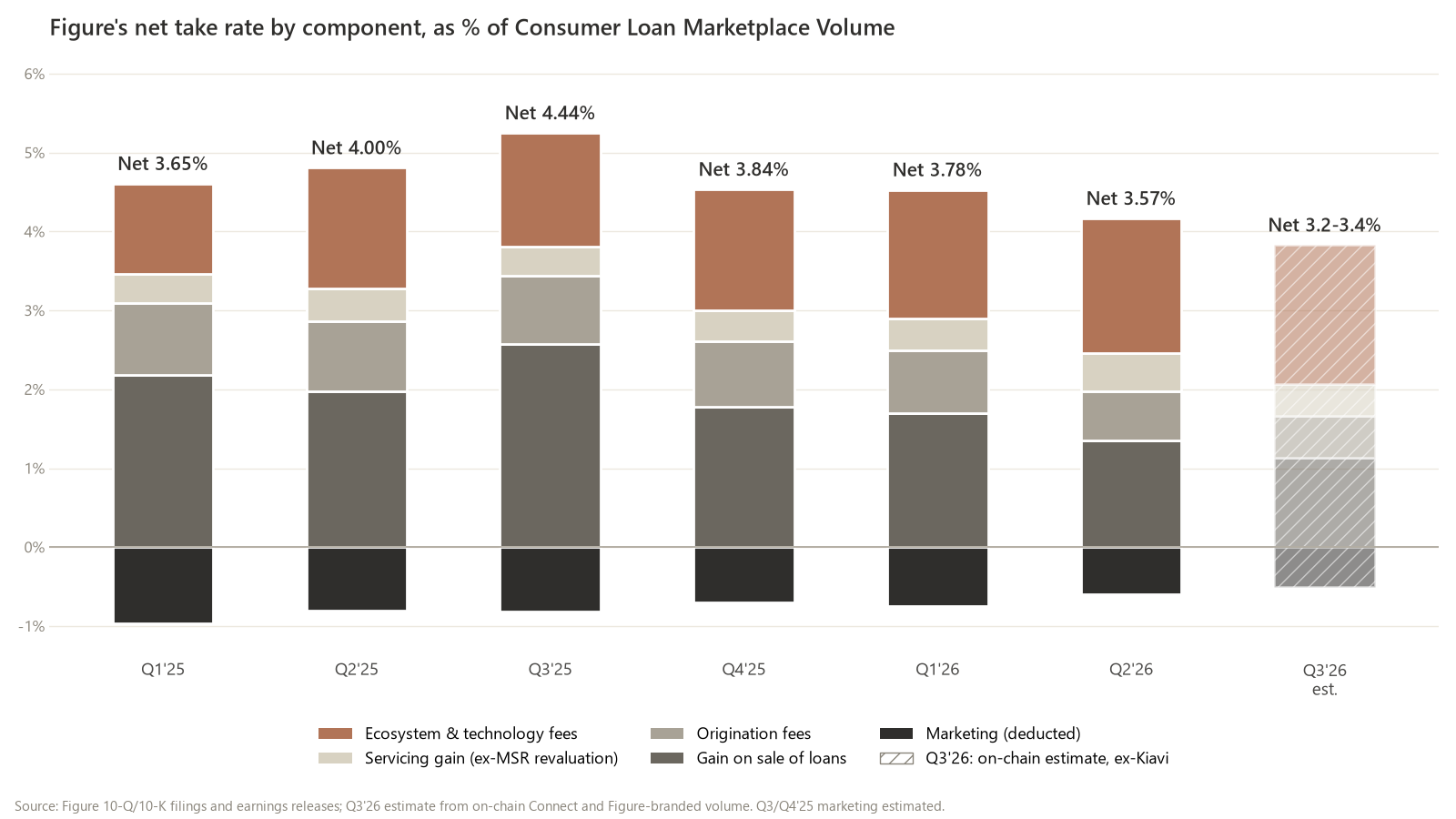
Fees (the terracotta component in the chart) keep growing, but gain on sale (the dark grey component) keeps shrinking as a share of total volume. As more volume moves to Connect, the overall take rate gradually comes down.
Now let's add Q3.
With an estimated 69%-72% of volume going through Connect, our calculation puts the take rate somewhere around 3.2%-3.4% – somewhat below the 3.5% lower end of management's expected range.
Getting back to 3.5% would require a stronger contribution from the loans Figure funds and sells, something like what we saw in Q3 last year.
This is all before Kiavi.
Kiavi is a different business altogether, and as Michael Tannenbaum noted last quarter, its inclusion "will add a new dynamic to take rate". Whether a higher one or lower - we'll wait to understand.
I specifically didn't go into the contribution margin numbers. There's very little that on-chain data can clue us in on there.
Next Quarter Estimations
Let's look at what we can already see for Q4.
Figure's official numbers so far stand at $2.02B of CLMV.
Kiavi has originated another $655M so far, although this number could be closer to $860M depending on how much of the loan commitments are counted. See the Kiavi section above.
On-chain data adds another $184M.
So where does that leave us?
Taking into account the holidays and the current pace of originations, we estimate Q4 Figure CLMV, excluding Kiavi, at around $4.6B-$4.8B.
That's roughly 6%-10% below Q3. With seasonality in mind, this isn't particularly surprising. It's also broadly in line with the Q4 pattern we saw last year, applied to October's activity – similar to how Figure's CFO built the Q3 guidance using July's numbers.
Now add Kiavi.
Based on its on-chain activity so far, we're looking at another $1.3B-$1.5B for the quarter, potentially more if the full loan commitments are counted.
That puts combined Q4 CLMV above Q3.
In other words, the headline number could show growth, while the underlying Figure business, excluding Kiavi, actually declines.
And that's probably one of the more interesting things to watch tomorrow: how much of the reported growth comes from the existing Figure business, and how much comes from the newly acquired one?
All numbers in this post are estimates based on on-chain data and Figure's public filings. Actual reported results may differ significantly. This is not investment advice.
Interested in following on-chain numbers closely? Sign in to Debloc.